
[Graduate Interview Series | Part Five] Meet 皮皮熊!

[Graduate Interview Series | Part Five] Part five is here! This time, we interviewed 皮皮熊! Their work with effects and logic gates really left an impression on us. Let's get today's interview startedーー
SODAART: What first got you interested in Live2D? Why did you want to learn it? 皮皮熊: In college, I loved watching Hololive and VTubers. I often watched 吧噗バブ's streams, too, and really enjoyed the happiness that comes from interacting with an audience. During my master's program, I took a class that was originally meant for thesis writing. The professor thought teaching thesis writing every time was getting too boring, and suddenly said, "Let's make a VTuber!" That was my first encounter with Live2D.
There wasn't anyone at school who could teach Live2D, so I had to explore it myself. But along the way, I discovered how much I enjoyed L2D modeling and wanted to keep learning more. Later, I heard on 玖玖巴老師's stream that she had learned Live2D through SodaArt's modeling class. After finishing my master's degree and returning from military service, I enrolled at SodaArt to study Live2D. That was when I really started down the path of Live2D modeling.
SODAART: Did you set yourself any goals when you first started learning? 皮皮熊: I set myself a goal of achieving something within two years. After becoming a Live2D modeler, I wanted to keep creating, learning, and improving. If I couldn't produce results, I would return to working in the food and beverage industry.
About the courses
SODAART: Was taking the class different from what you expected? 皮皮熊: Classes ran quite long and rarely ended on time. But for me, the teachers' willingness to spend more time explaining Live2D fundamentals and answering related questions was really helpful.
SODAART: What was your biggest takeaway from the modeling class? 皮皮熊: Meeting friends and more experienced creators who are still working hard in the Live2D industry. I didn't just take the full-pipeline V5 modeling class; I also enrolled in A3 animation and E1 extended techniques. Even now, after the courses have ended, we still exchange ideas and discuss things together. We also point out what one another could improve, because everyone wants to make better models. Having people who are willing to tell me directly what needs work has been a particularly valuable part of the experience.
SODAART: Which lessons left the strongest impression on you? 皮皮熊: I was in V5, though I don't remember which week it was. Soda老師 taught an effects lesson covering things like multiple following stars and data-style effects. Guest instructor Thya老師 also taught body-physics reverse binding. Those lessons really stuck with me. Body reverse-binding setups aren't needed anymore, since VTS can now handle those adjustments itself, but those classes sparked my interest in Live2D effects and logic gates.
SODAART: Do you remember any particularly meaningful advice from a teacher or teaching assistant? 皮皮熊: I remember the teachers and assistants getting along very well with everyone. Whenever we had questions, the assistants responded enthusiastically and offered practical advice. It's hard to pick one person whose advice meant the most, because every teacher's and assistant's feedback was important to me.
If you're having trouble with modeling and see 無痕助教, though, just call out, "無痕A夢, help me!" 無痕助教 will definitely come to your rescue with some advice ●ᴥ●
SODAART: What helps you most about having an assistant look over your work? 皮皮熊: After an assistant points out a problem, my most direct response is to fix it and compare the result with how it looked before. If I only know about a problem without actually going back to change it, the benefit is limited. Doing the correction myself is what turns that feedback into real experience.
About modeling
SODAART: Which part of modeling do you enjoy most? 皮皮熊: I really like effects and logic gates. They're difficult to put into practice and aren't mainstream parts of Live2D modeling at the moment. They're more like techniques that add an extra touch to the result, but I really enjoy studying them.
SODAART: Are there any modeling details you're especially particular about? 皮皮熊: I'm quite particular about how complete the whole model feels. A Live2D modeler might make a beautiful nine-axis head, but if other parts—such as physics, body turns, hair movement, or expression animations—are weaker, the model can end up looking strange when everything is put together.
SODAART: What do you find most difficult about modeling? 皮皮熊: I actually don't find the process especially painful; I've enjoyed modeling throughout my learning journey. Quite a few classmates do ask me privately how to create effects and logic gates, though. Those areas really are harder to learn, because you need to understand how to separate the parts of an effect as well as the fundamentals of Live2D physics before you can apply logic gates.
Before working on those techniques, I'd recommend getting a solid grasp of Live2D's fundamentals, then gradually moving into more advanced material. Focusing too much on effects and logic gates at the beginning can make it easy to lose your direction or overlook more important skills, such as smooth transitions between an object's angles and perspective. It's perfectly fine to come back to the advanced techniques once your fundamentals are stable.
SODAART: What gives you the biggest sense of achievement? 皮皮熊: Being able to connect with viewers and create more fun interactions through models I've made myself. Seeing people enjoy those interactions gives me a real sense of achievement.
SODAART: How would you describe your modeling style or its defining features? 皮皮熊: A lot of people say the faces I make have an idol-like style. But when it comes to pets or effect-toy toggles, I get quite mischievous. I've made a cat that shoots out a jet of white light, turned an ahoge or a tail into a big pinwheel, and made both eyes turn outward with a toggle I call the "wise gaze." When squeezing a pet penguin's face, I've also made it stretch out really long. I suppose you could call it idol-style mischief ●ᴥ●
SODAART: Are there any techniques you'd still like to try? 皮皮熊: In terms of commissions, I haven't had many opportunities to work on male VTuber models; most of my commissions have been female models. I've talked about this with friends before, and I hope there will be more commissions for male models in the future so modelers have more chances to explore them.
I'd also really like to try using Live2D to make a game. Some friends around me are already creating and selling work in that area, and seeing it has made me interested, too. I hope I'll have a chance to take part in making one someday.
To finish
SODAART: Do you have any advice for people who are about to start the course? 皮皮熊: Focus on making one model well. During V5, some classmates tried to make three models at once, but their learning results weren't as good. It's better to complete one model properly, solve each problem as it comes up, and build up solid experience that way.
Learning Live2D doesn't have to start with the assumption that it absolutely must become your career. It can be a way to gain another skill and give yourself more options for the future. You never know when it might come in useful. Finding enjoyment in the learning process and turning it into the motivation to keep going is a mindset you can use anywhere.
And one final suggestion: try playing around with Live2D before class starts. It'll make things much easier ●ᴥ●
Keep reading
-

[Graduate Interview Series | Part 4] Let’s hear from Una!
Part 4 of Una’s graduate interview series. She talks about what led her to Live2D, what she gained from the class, her modeling details and what she wants to try next.
-
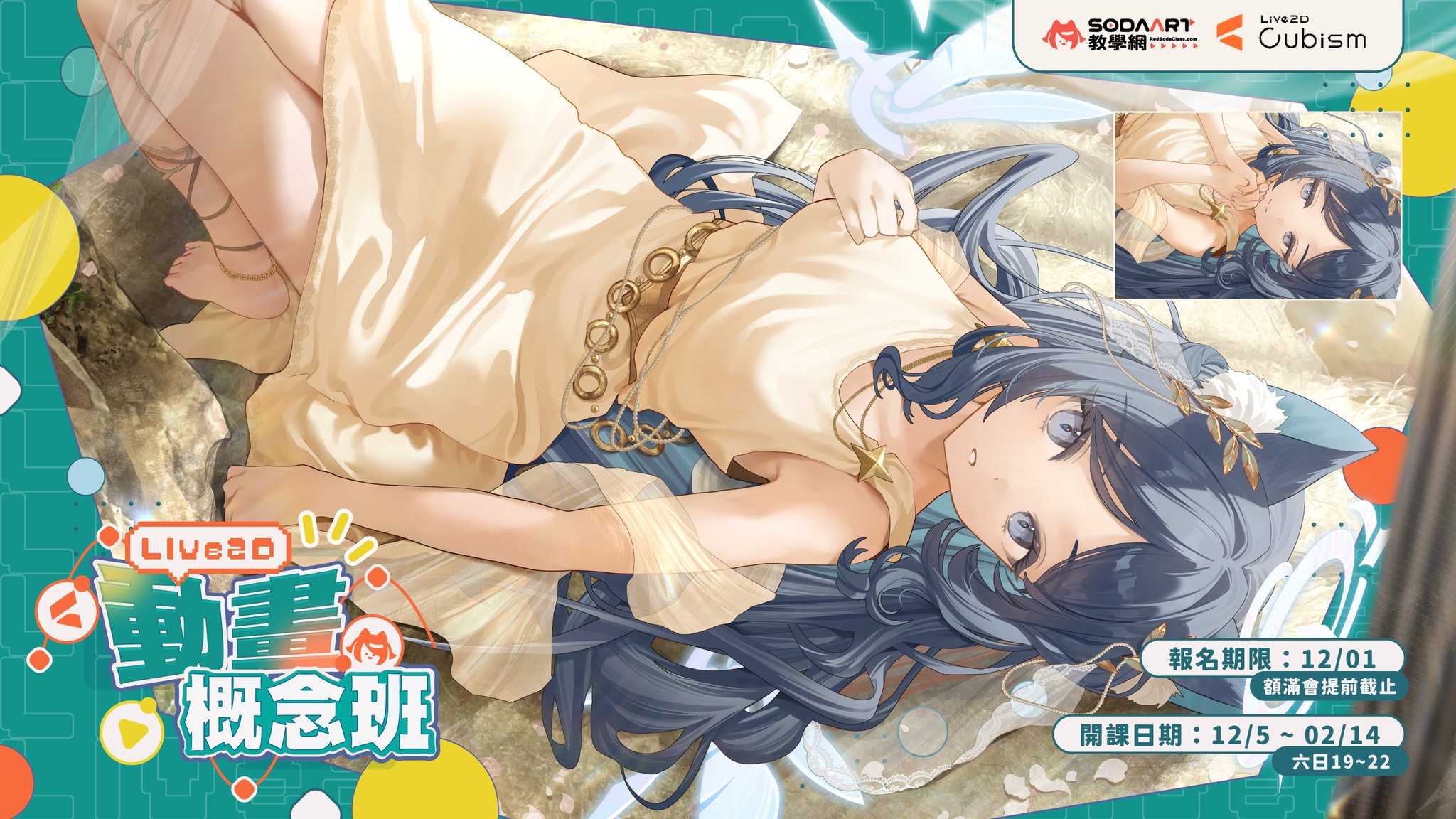
[Animation Class, Session 6 Enrollment]
An update on the Session 6 Animation Class course image: the collaboration illustration has been replaced, while scholarships and event rules stay the same.
-

[Animation Class Cohort 6 Enrollment] Day 5: Refined large-format reference sheets are ready
Day 5 of Animation Class Cohort 6 enrollment, featuring refined reference sheets and a back-view illustration provided by 馬吉Machi老師.